2025–2026 / NDA · AI EDTECH
From product opportunity to AI learning experience
R&D: Product Designer (Discovery & Validation) · Venture: Founding Product Designer
Discovery & strategy · User research & validation · End-to-end UX/UI · MVP development · Post-launch iteration
AI-powered learning experiences across web and mobile · Functional MVPs · Product, growth, and monetization experiments
Across multiple product initiatives, I identified learning problems worth exploring, shaped them into testable concepts, and carried selected directions through MVP development and launch.
USERS
People learning for school, work, or personal growth.
BUSINESS CONTEXT
Evolving an existing product while exploring new AI opportunities.
CONSTRAINTS
Validate fast before investing in development.
Moving from R&D to Venture changed the questions we were answering: from whether an opportunity was worth pursuing to whether the product could deliver clear value, earn trust, and give learners a reason to return.
CHALLENGE Finding ideas wasn’t the hard part. The challenge was knowing which ones could create enough value to build.
We looked beyond individual product ideas to understand the broader learning landscape: emerging trends, how students study, and their everyday challenges. From there, we identified promising opportunities and used four key questions to help us decide where to focus.
01 / PROBLEM
Is this a real learning problem?
I mapped recurring learning needs and market patterns to separate meaningful problems from short-lived AI trends.
02 / DEMAND
Do students care enough to act?
I tested early concepts with prospective users and moved ideas forward only when the demand signal was clear.
03 / AI VALUE
Does AI improve the experience?
I explored different directions to identify where AI could reduce effort or meaningfully improve learning.
04 / EVIDENCE
Does it hold up in practice?
I turned selected concepts into functional prototypes to evaluate usability and feasibility before deeper investment.
Together, these questions helped us filter ideas and identify which opportunities were worth taking further.
Different learning problems. Different product approaches.
I worked across a range of AI-powered learning products on web and mobile, turning specific learning needs into focused product experiences. The selected examples show my work across product definition, core flows, validation, MVP delivery, and iteration.
ACADEMIC WRITING · WEB
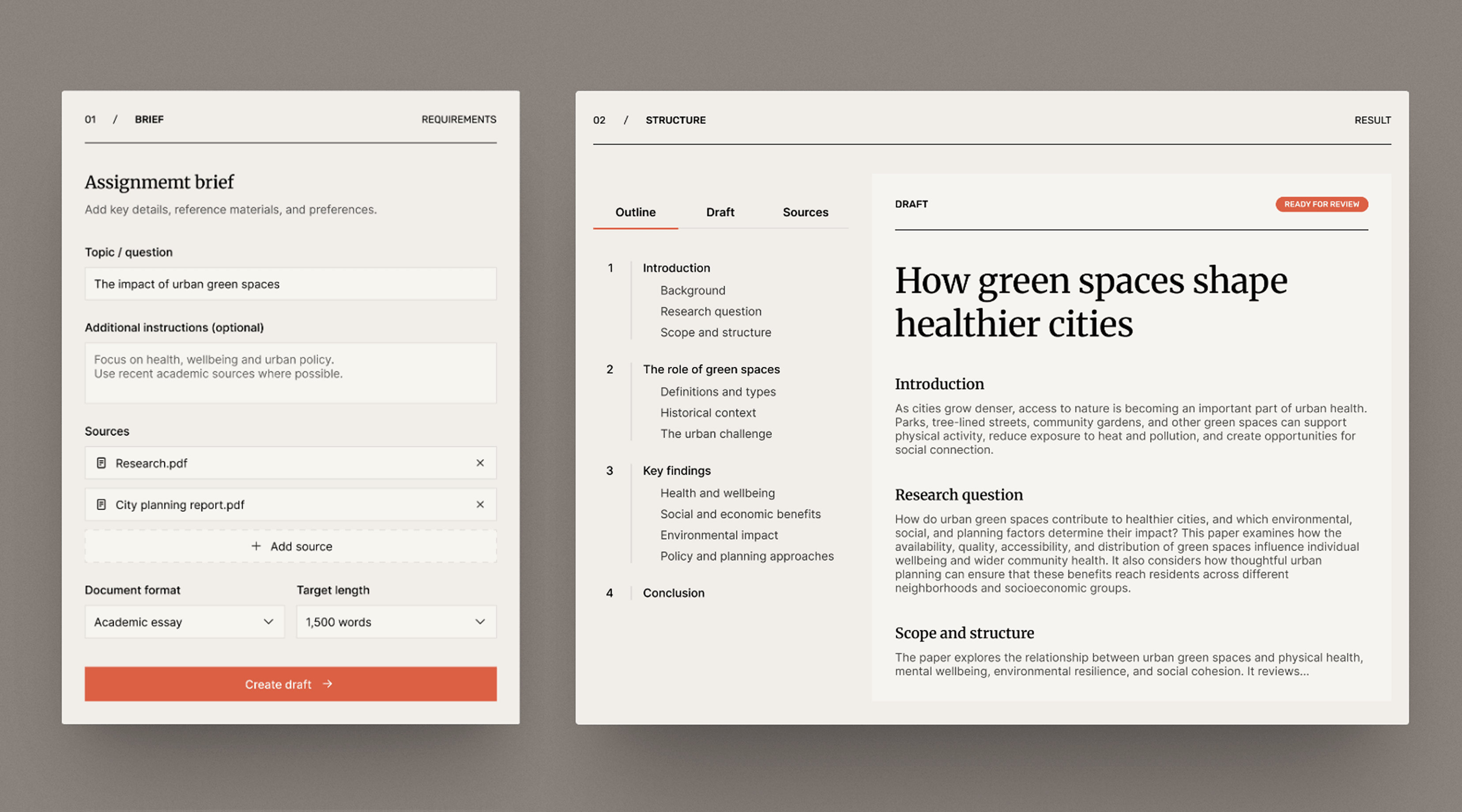
Guiding students from a blank page to a structured draft
Students under time pressure needed a clearer way to develop academic drafts while staying confident in their sources, quality, and originality.
What I did:
- Designed end-to-end writing flows
- Integrated quality & originality checks
- Tested monetization & paywall flows
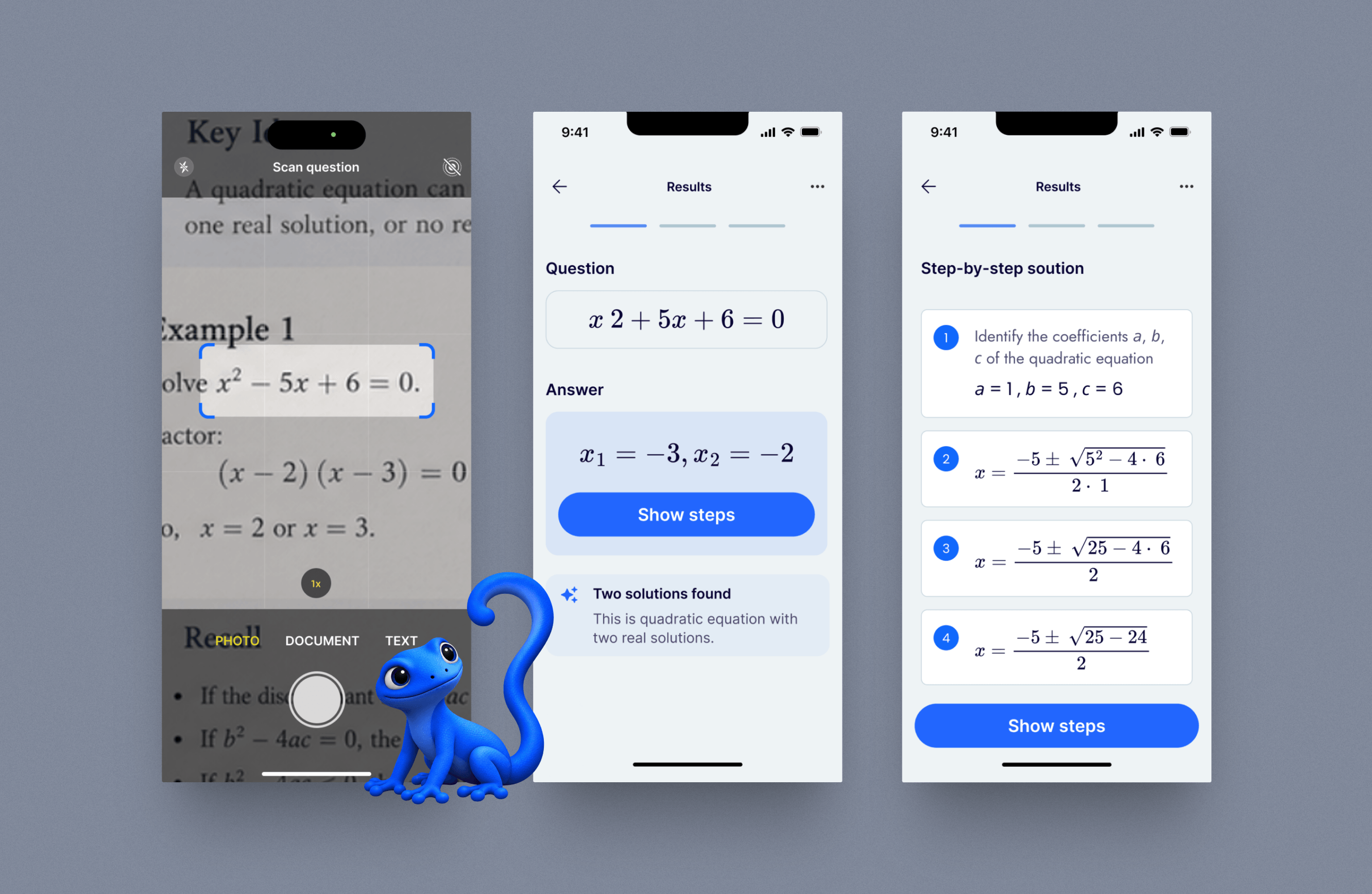
MATH SOLVER · iOS
Instant step-by-step math help
Students needed more than quick AI answers. They needed reliable help with explanations they could use anywhere. We explored a mobile-first way to capture problems and understand how to solve them.
What I did:
- Simplified capture, crop, and rescan
- Designed clear step-by-step solution flows
- Designed history and repeat solving
- Created and validated a product mascot
STUDY & PRACTICE · WEB & MOBILE
From study materials to active practice
Students had plenty of study materials, but preparing for exams meant jumping between scattered sources and losing context. We explored how to turn everything they already had into one connected study experience.
What I did:
- Validated demand with real users
- Designed upload, customization, and review
- Built quizzes, flashcards, and AI notes
PRE-LAUNCH DESIGN · MOBILE
Structuring AI learning into guided programs
People with little technical or AI experience struggled to use AI for real tasks in their own fields. We designed a guided, hands-on way to build practical AI skills step by step.
What I did:
- Structured tools, skills, and programs
- Designed guided learning paths
- Explored positioning for different needs
KEY LESSON Launching products showed me what early validation could not: real value emerges through behavior, trust, and reasons to return.
Validation continues after launch
Early testing reduced uncertainty, but real behavior revealed where the value held and where the experience still needed to change.
Trust matters as much as speed
Students needed more than fast AI outputs. Clear steps, reliable sources, editing controls, and quality signals made results more useful and trustworthy.
Useful once is not enough
Solving an immediate task could drive initial use, but sustainable growth depended on giving people a reason to return.
I used post-launch behavior and user feedback to refine positioning, flows, and monetization experiments, and to decide which directions were worth continuing.